PIECE PRACTICE GUIDE · J. S. BACH · BWV 779
Bach Invention No. 8 in F major.
How to practice it, bar by bar.
Invention No. 8 is one of the brightest of Bach’s fifteen two-part inventions: 34 bars in 3/4, built on a leaping F major arpeggio that the left hand answers one bar later. This guide breaks it into sections, points out the bars that usually cause trouble, and gives you a two-week practice plan.
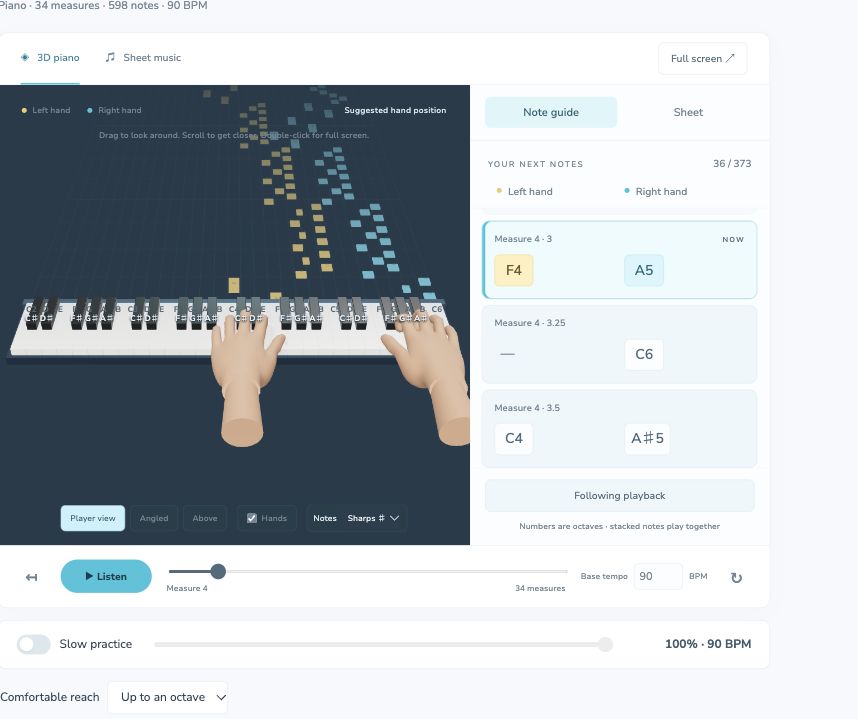
The whole piece is loaded in the free Stavewise demo, so you can hear each hand, slow it down and follow it on a 3D piano while you read.
The piece at a glance.
| Composer | Johann Sebastian Bach (1685–1750) |
|---|---|
| Catalogue | BWV 779, from the Two-Part Inventions (BWV 772–786) |
| Key and time | F major, 3/4 |
| Length | 34 bars, roughly a minute at a lively tempo |
| Texture | Two voices, one in each hand, imitating each other |
| Skills it builds | Even sixteenth notes, hand independence, broken-chord shapes, quick shifts across the keyboard |
A map of the piece.
Knowing where the music is going makes it far easier to memorize. The bar numbers below match the score in the Stavewise demo.
| Bars | What happens | Key area |
|---|---|---|
| 1–3 | The right hand plays the theme alone: an eighth-note F major arpeggio leaping up, then a sixteenth-note run down. In bar 2 the left hand enters with the same theme an octave lower, exactly one bar behind. | F major |
| 4–6 | Both hands switch to rocking sixteenth-note figures (A–C–B♭–C in the right hand) that step downward bar by bar. | F major |
| 7–11 | B naturals appear and long sixteenth-note scales pass between the hands. | Moving to C major |
| 12–14 | The music comes to rest in C, then the theme returns in C major. This time the left hand leads and the right hand follows a bar later. | C major |
| 15–18 | E♭ and F♯ arrive, and the arpeggio-and-run theme passes between the hands in G minor. | G minor |
| 19–23 | C♯ points to D minor. The right hand alternates between a held high note and a moving line beneath it, in a falling sequence. | D minor |
| 24–28 | The left hand alternates a repeated note (D, then C) with a bass line moving underneath, then both hands return to the rocking sixteenths from bars 4–6. | Toward B♭ major |
| 29–34 | A C seventh arpeggio in bar 29 leads home. The closing scales in bars 30–33 mirror bars 8–11, now in F, and the piece ends on F. | F major |
The bars that usually need extra work.
Bars 4–6 and 26–28: the rocking sixteenths
These look simple but expose any unevenness. Keep the hand close to the keys and let a small rotation of the forearm do the work rather than lifting each finger. Practice each hand alone at half tempo until every sixteenth is the same size, then put the hands together.
Bars 8–11: scales passing between the hands
The run often starts in one hand and continues in the other. Listen for a single unbroken line. Practice the hand-to-hand handover as a tiny exercise: the last three notes of one hand and the first three of the other.
Bars 15 and 19–23: right-hand leaps
In bar 19 the right hand jumps repeatedly between B♭5 and C♯5, and bars 21–23 alternate between a high note and a line below it. Look ahead to the landing note, keep the thumb relaxed, and practice the jump as a single motion before adding the notes in between.
Bars 24–25: the left-hand repeated notes
The left hand keeps returning to a repeated note while a bass line moves underneath it, starting with an octave leap. Practice the bass notes alone first, then add the repeated note, keeping it light so the moving line stands out.
A two-week practice plan.
Ten to twenty focused minutes a day is enough. Use a tempo where you can play every note correctly, even if it feels slow. In Stavewise, slow practice and phrase practice let you set that tempo and loop one or two bars.
- Days 1–2: Listen to the whole piece in the demo while following the score. Then play bars 1–7, right hand alone, then left hand alone.
- Days 3–4: Hands together for bars 1–7 at a slow tempo. Add bars 8–14 hands separately.
- Days 5–7: Hands together through bar 14. Start bars 15–23 hands separately, isolating the leaps in bars 19–23.
- Days 8–10: Hands together through bar 23. Learn bars 24–34 hands separately; give the left hand in bars 24–25 its own short sessions.
- Days 11–12: Hands together for the whole piece at a steady, slow tempo. Mark any bar that breaks down and loop just that bar.
- Days 13–14: Raise the tempo in small steps. Play the piece through once a day without stopping, even if there are slips.
For fingering, the suggestions on the 3D hands are a starting point. Choose a fingering that keeps the sixteenths even and stick to it every time you practice, and ask a teacher if a passage feels tense.
Practicing it in Stavewise.
The free demo contains the complete 34-bar score, transcribed from the public-domain Bach-Gesellschaft edition. You don’t need an account.
- Choose right hand, left hand or both, and hear only that part.
- Turn on slow practice to bring the tempo down while you learn the notes.
- Use phrase practice to pick a starting bar and loop one or two bars, such as bar 19.
- Follow the 3D piano guide to see where each hand goes next.
- Use Wait for me with your microphone or the on-screen keys, so the music only moves on when you play the right note.
Questions about Invention No. 8.
How hard is Bach’s Invention No. 8?
It is usually taught at an intermediate level and is often one of the first inventions students learn, because the theme is a simple broken chord. The challenges are keeping sixteenth notes even, coordinating two independent hands and the right-hand leaps around bars 19–23.
How long is the piece?
It is 34 bars in 3/4 time and usually lasts around a minute, depending on tempo. The Stavewise demo plays it at 90 quarter notes per minute, and you can slow it down.
Is the sheet music free?
Yes. The music is public domain. The Stavewise demo uses a public-domain transcription from the Mutopia Project, based on the Bach-Gesellschaft edition. See the credits for details.
Which invention should I learn next?
Many students pair No. 8 with Invention No. 1 in C major or No. 4 in D minor, which use similar sixteenth-note writing. Your teacher can suggest the best order for you.
Continue exploring.
Play Invention No. 8 now.
The full piece is waiting in the free demo. Choose a hand, slow it down and follow the 3D piano.
Open the free demo →